William Prescott was born in Groton, Massachusetts on February 20, 1726. Before the Revolution he was successively major, lieutenant-colonel, and colonel in the militia, early in 1776 he was appointed a brigadier-general(Nathaniel Greene also reached the rank of Brigadier-general during the Revolution) of militia for the county of Middlesex. In 1774 he was appointed to command a regiment of minute-men, with which he marched, on 19 April, 1775, to Lexington, to oppose the expedition that was sent out by General Thomas Gage. Before Prescott arrived the British had retreated. The towns of Lexington and Concord were warned of the British attack by Paul Revere, Samuel Prescott, and William Dawes.They were told to warn Lexington and Concord by Dr. Joseph Warren and to ride from Boston to Lexington to warn John Hancock and Samuel Adams(Cousin of John Adams) of the movements of the British Army.
He was an American Colonel in the Revolutionary War who commanded the forces in the battle of Bunker Hill. His famous words at the battle were "Do not fire until you see the whites of their eyes," he said this because they needed to conserve ammunition. A large British force commanded by General William Howe attacked the Colonists with three waves of troops, the first two failed to make the colonists retreat, but the third succeeded. After the battle, his militia unit was adopted into the newly created Continental Army which was led by Genral George Washington, and he was commissioned the colonel of what became the 7th Continental Regiment. The regiment was active in the battles for New York City in 1776 and the Saratoga Campaign of 1777. Benedict Arnold also served at Saratoga. Early in 1777(Before the Saratoga Campaign) he resigned and returned home, but in autumn of that year he joined the northern army under General Horatio Gates as a volunteer. Prescott was present at the surrender of General Burgoyne after Saratoga as was Colonel Daniel Morgan, and Horatio Gates.
I believe that William Prescott should be recognized more for what he did, because many people probably don't know much about him. I think he should have a holiday to celebrate for him like when we celebrate Martin Luther King day.
Wednesday, April 30, 2008

Wednesday, April 9, 2008
The Boston Massacre Essay #1
Gentlemen of the jury, on the day of the murder the sentinel was at his post and some boys came up to talk with him about a debt he owed, the sentinel struck one of them with his gun, knocking him to the ground. A crowd gathered around taunting him. He called for help and the church bell rang calling for the soldiers to help him. People came out of their houses at the sound of the bell, making the crowd larger and louder. Captain Preston came leading is troops and ordered them to load their muskets, and ordered them to fire, mercilessly murdering 5 and wounding 6 innocent civilians.
I believe that Captain Preston is responsible for the massacre because he and only he gave the order to fire murdering 5 civilians. The soldiers under his command carried out his order which makes them responsible for the 5 murders also.
I believe that Captain Preston should be hanged and the soldiers should also be hanged for the murder of 5 innocents. This will make the king see how undisciplined his army is and coerce him to make improvements on discipline. The people of Massachusets will be releived to see that the murderers were brought to justice by being hanged, and won't have to fear for their families innocent lives.
I believe that Captain Preston is responsible for the massacre because he and only he gave the order to fire murdering 5 civilians. The soldiers under his command carried out his order which makes them responsible for the 5 murders also.
I believe that Captain Preston should be hanged and the soldiers should also be hanged for the murder of 5 innocents. This will make the king see how undisciplined his army is and coerce him to make improvements on discipline. The people of Massachusets will be releived to see that the murderers were brought to justice by being hanged, and won't have to fear for their families innocent lives.
Tuesday, April 1, 2008
Quarter Four Notes
Revolution and War
1763-1789
 1764—Grenville Acts (direct tax)
Sugar (molasses, wine)
Stamp
Quartering
Currency
Virtual/ Direct Representation

5 people were killed propaganda was used in the picture to make people fight. picture made by Paul Revere.
 1773—Boston Tea Party
November 30, 1773--Dartmouth sails into Boston Harbor
December 16, 1773--Tea dumped into harbor
340 chests of tea dumped (value of 10,000 British pounds)
1763-1789
Revolution Notes
1763—Proclamation Act
Line that tells what the Indian's can have and Britain cannot take, the Appalachian mountains.
 1764—Grenville Acts (direct tax)
Sugar (molasses, wine)
Stamp
Quartering
Currency
Virtual/ Direct Representation
Direct tax of sugar and stamps, British troops were quartered in the colonists home and they couldn't do anything about it.Britain wanted them to use their currency.
1765—Stamp Act Congress
Sons of Liberty
Samuel Adams
Paul Revere
John Hancock
Propaganda
Boycotts
Lobsters (Lobster-backs, Thomas Lobster)
Sons of Liberty
Samuel Adams
Paul Revere
John Hancock
Propaganda
Boycotts
Lobsters (Lobster-backs, Thomas Lobster)
First time colonies sent delegates to discuss issues against Britain.
1766—Declaratory Act
Britain took away the taxes but declared that they have the power to tax them anytime they want.
1767—Townsend Acts (indirect tax)
Charles Townsend
Writs of Assistance (search warrants)
Revenue used to pay Royal officials in the colonies
Tea Act (glass, paper, paint) support British East India Company
Charles Townsend
Writs of Assistance (search warrants)
Revenue used to pay Royal officials in the colonies
Tea Act (glass, paper, paint) support British East India Company
Taxing glass, paper, and paint second attempt to tax colonies.
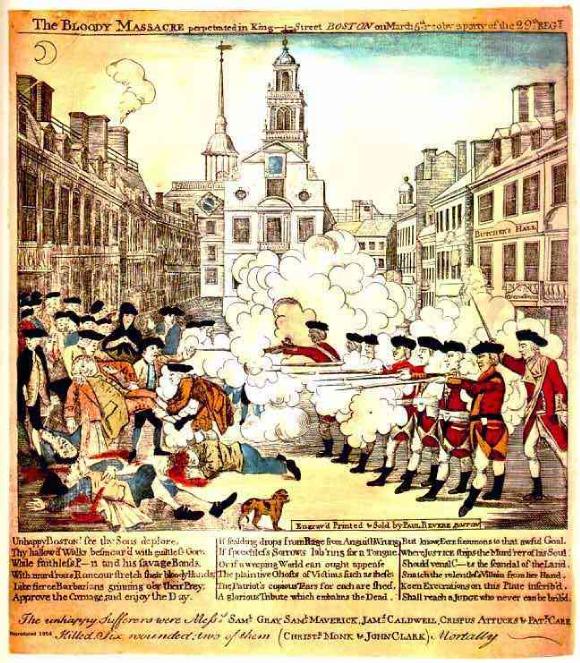
1770—Boston Massacre
March 5, 1770
Local reaction (primarily)
5 dead colonists
John Adams defends British soldiers/5 exonerated-2 convicted
Convicted men discharged and thumbs branded
March 5, 1770
Local reaction (primarily)
5 dead colonists
John Adams defends British soldiers/5 exonerated-2 convicted
Convicted men discharged and thumbs branded
5 people were killed propaganda was used in the picture to make people fight. picture made by Paul Revere.
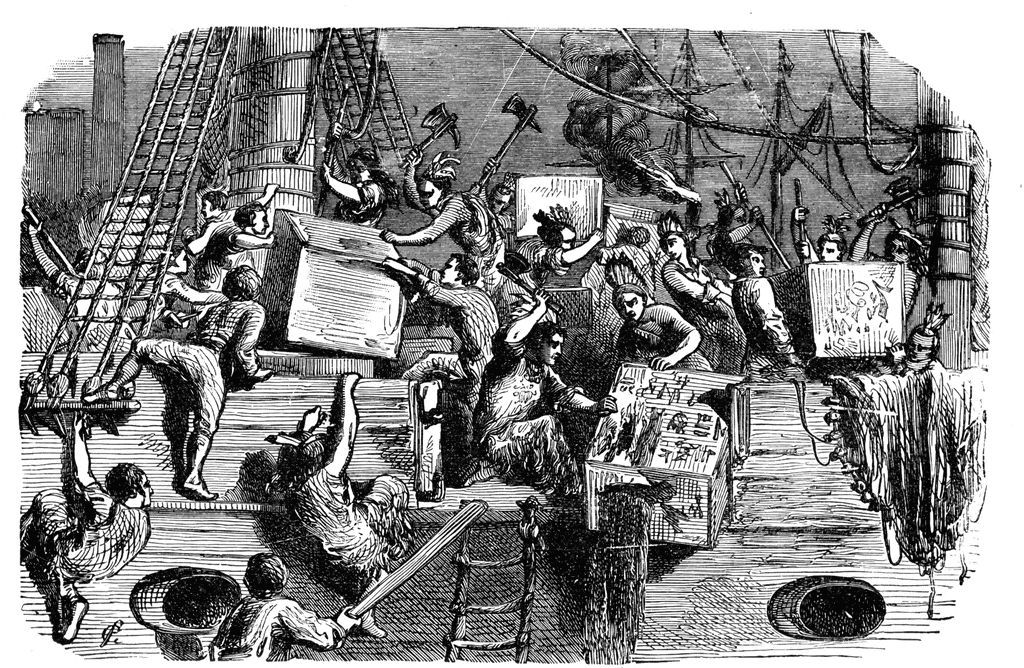 1773—Boston Tea Party
November 30, 1773--Dartmouth sails into Boston Harbor
December 16, 1773--Tea dumped into harbor
340 chests of tea dumped (value of 10,000 British pounds)
British taxed their tea so Samual adams got men angry and had them throw 340 chests of tea into the sea. This cost the the british 10,000 pounds which started the intolerable acts.
 1774—1st Continental Congress
September to October (7 weeks)
Carpenter’s Hall, Philadelphia
New England—John Adams, Paul Revere, Silas Deane
Virginia—Washington, Patrick Henry, Peyton Randolph, Richard Henry Lee
Pennsylvania—John Dickenson, Joseph Galloway (Plan for American council under Parliament, to avoid war)
New York—John Jay, James Duane
Maryland—Samuel Chase (future Supreme Court Justice), Charles Carroll (richest man in Maryland, Catholic)
Declaration of Rights—rejects Parliamentary authority over internal colonial affairs, colonies manage own defense, united aid to Boston if Intolerable Acts continue, absolute boycott of British goods to be enforced rigidly
 1776—January, Common Sense
Written by Thomas Paine
120,000 copies sold in three months
 1776—Declaration of Independence
June 7, Richard Henry Lee (Virginia) introduces legislation to declare independence from Britain
Before voting on Lee’s proposal Congress appoints five-man committee to draft a formal Declaration of Independence (Thomas Jefferson, 33, does most of the writing)
June 28, Declaration presented to Congress
July 2, Congress approves Lee’s legislation to declare the United States of America independent of Great Britain
July 4, Congress officially adopts the Declaration of Independence
The Declaration intended to:
Undermine loyalty to King George III
Outline basic principles of representative government
Establish the “right” of rebellion
 1776—December, Battle of Trenton
Howe believes war almost won
1,400 Hessians stationed at Trenton
Colonel Rall (Hessian) builds no fortifications
Washington “Crosses the Delaware” Christmas night
2,500 men; 18 artillery guns
Surprise attack at dawn
106 Hessians killed, 918 captured
No colonial casualties
Washington retreats in secret to avoid Gen. Cornwallis counter-attack
 1777-1778—Winter at Valley Forge
Under-funded troops
Low morale
10,000+ troops
4,000 troops listed as “unfit for duty” due to poor supplies (boots, blankets, coats, etc.)
2,500 troops die of disease (typhus, typhoid fever, dysentery, pneumonia)
George Washington mentioned a lack of shoes so severe that the men's "marches might be tracked by the blood from their feet”
Local farmers would sell produce to Brits who could pay cash

1774—Intolerable Acts (Coercive Acts in Britain)
Close the port of Boston
Shut down Provincial and Town Governments
All offices appointed
Named General Thomas Gage as Governor
Gave all western lands north of the Ohio R. to Quebec, allowed Catholic Church to practice
Close the port of Boston
Shut down Provincial and Town Governments
All offices appointed
Named General Thomas Gage as Governor
Gave all western lands north of the Ohio R. to Quebec, allowed Catholic Church to practice
Because of the boston tea party they closed the port of boston and shut down our government.
 1774—1st Continental Congress
September to October (7 weeks)
Carpenter’s Hall, Philadelphia
New England—John Adams, Paul Revere, Silas Deane
Virginia—Washington, Patrick Henry, Peyton Randolph, Richard Henry Lee
Pennsylvania—John Dickenson, Joseph Galloway (Plan for American council under Parliament, to avoid war)
New York—John Jay, James Duane
Maryland—Samuel Chase (future Supreme Court Justice), Charles Carroll (richest man in Maryland, Catholic)
Declaration of Rights—rejects Parliamentary authority over internal colonial affairs, colonies manage own defense, united aid to Boston if Intolerable Acts continue, absolute boycott of British goods to be enforced rigidly
1775— January
William Pitt urges Parliament to withdraw troops from America because the idea of managing the colonies through force was “too ridiculous to take up a moment of your lordships’ time”
William Pitt urges Parliament to withdraw troops from America because the idea of managing the colonies through force was “too ridiculous to take up a moment of your lordships’ time”
1775—April 19 Lexington and Concord
Gen. Gage sends 700 men to Concord to seize the powder supplies
Paul Revere and William Dawes raise alarm the night before
Town of Lexington is on the way to Concord
Minutemen are assembled on the town common
“Shot heard round the world”
18 colonials killed and the rest run away
British march on to Concord and find the munitions were moved overnight
Minutemen ambush the British the whole way back to Boston
430 Redcoats make it back to Boston
30,000 Colonists surround Boston
Gen. Gage sends 700 men to Concord to seize the powder supplies
Paul Revere and William Dawes raise alarm the night before
Town of Lexington is on the way to Concord
Minutemen are assembled on the town common
“Shot heard round the world”
18 colonials killed and the rest run away
British march on to Concord and find the munitions were moved overnight
Minutemen ambush the British the whole way back to Boston
430 Redcoats make it back to Boston
30,000 Colonists surround Boston
1775—May
Gen. Howe, Gen. Clinton, Gen. Burgoyne
5,000 British troops
Ethan Allen, “Green Mountain Boys” seize Fort Ticonderoga
Henry Knox uses canon to lay siege on Boston
Benedict Arnold (Connecticut) takes Fort Crown Point to impede an invasion from Canada
Gen. Howe, Gen. Clinton, Gen. Burgoyne
5,000 British troops
Ethan Allen, “Green Mountain Boys” seize Fort Ticonderoga
Henry Knox uses canon to lay siege on Boston
Benedict Arnold (Connecticut) takes Fort Crown Point to impede an invasion from Canada
1775—May 10, 2nd Continental Congress
Sam Adams pushes for Independence
John Dickenson (Penn.) urges restraint
Agree to form Colonial Army
Delegates unanimously agree to Washington as Commander of Continental Army (John Adams suggestion)
Sam Adams pushes for Independence
John Dickenson (Penn.) urges restraint
Agree to form Colonial Army
Delegates unanimously agree to Washington as Commander of Continental Army (John Adams suggestion)
1775—June 17, “Battle of Bunker Hill”
Actually fought on Breed’s Hill
Gen. Howe leads assault without canon support (his canon had been matched with wrong-sized cannonballs [Amherst at Ticonderoga])
Militia waited to within 30 yards (some say 15 yards)
Militia target British officers
Militia ran extremely low on ammunition
On the third assault, led by Gen. Howe, British troops overtake the colonial position
Britain losses almost 1000 men (about half the attacking force)
Colonials lose about 500 men
Actually fought on Breed’s Hill
Gen. Howe leads assault without canon support (his canon had been matched with wrong-sized cannonballs [Amherst at Ticonderoga])
Militia waited to within 30 yards (some say 15 yards)
Militia target British officers
Militia ran extremely low on ammunition
On the third assault, led by Gen. Howe, British troops overtake the colonial position
Britain losses almost 1000 men (about half the attacking force)
Colonials lose about 500 men
 1776—January, Common Sense
Written by Thomas Paine
120,000 copies sold in three months
1776—March
Gen. William Howe evacuates Boston
July 2, lands in Staten Island, New York (Loyalist base)
Gen. William Howe evacuates Boston
July 2, lands in Staten Island, New York (Loyalist base)
 1776—Declaration of Independence
June 7, Richard Henry Lee (Virginia) introduces legislation to declare independence from Britain
Before voting on Lee’s proposal Congress appoints five-man committee to draft a formal Declaration of Independence (Thomas Jefferson, 33, does most of the writing)
June 28, Declaration presented to Congress
July 2, Congress approves Lee’s legislation to declare the United States of America independent of Great Britain
July 4, Congress officially adopts the Declaration of Independence
The Declaration intended to:
Undermine loyalty to King George III
Outline basic principles of representative government
Establish the “right” of rebellion
War
1776—August, Brooklyn Heights, New York
Largest Naval group Britain will launch until the 20th century
British victory, city falls to England
As winter came “sunshine patriots” left the American Army
Initial colonial enlistments due to expire
Largest Naval group Britain will launch until the 20th century
British victory, city falls to England
As winter came “sunshine patriots” left the American Army
Initial colonial enlistments due to expire
 1776—December, Battle of Trenton
Howe believes war almost won
1,400 Hessians stationed at Trenton
Colonel Rall (Hessian) builds no fortifications
Washington “Crosses the Delaware” Christmas night
2,500 men; 18 artillery guns
Surprise attack at dawn
106 Hessians killed, 918 captured
No colonial casualties
Washington retreats in secret to avoid Gen. Cornwallis counter-attack
1777—January, Princeton
Washington ambushes British troops
Colonial victory establishes this will not be a quick war for Britain
Washington ambushes British troops
Colonial victory establishes this will not be a quick war for Britain
1777—September-October, Saratoga
Gen. Burgoyne plans a three-prong attack on colonials at Albany
Plan does not consider the terrain, forcing British troops to march through swamps, lakes, hills and forests full of rebels
Two of the three “prongs” never arrive (Howe goes to Philadelphia instead, St. Leger retreats to New York afraid of Benedict Arnold)
Sept. Burgoyne crosses Hudson River
Oct. 17, Burgoyne surrenders
Establishes American Army as real threat
Helps secure open French Alliance
Turning Point of the War
Gen. Burgoyne plans a three-prong attack on colonials at Albany
Plan does not consider the terrain, forcing British troops to march through swamps, lakes, hills and forests full of rebels
Two of the three “prongs” never arrive (Howe goes to Philadelphia instead, St. Leger retreats to New York afraid of Benedict Arnold)
Sept. Burgoyne crosses Hudson River
Oct. 17, Burgoyne surrenders
Establishes American Army as real threat
Helps secure open French Alliance
Turning Point of the War
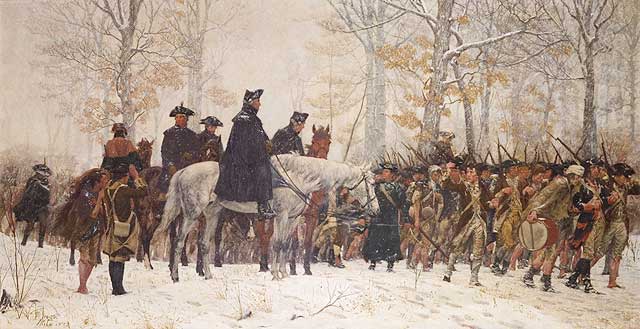 1777-1778—Winter at Valley Forge
Under-funded troops
Low morale
10,000+ troops
4,000 troops listed as “unfit for duty” due to poor supplies (boots, blankets, coats, etc.)
2,500 troops die of disease (typhus, typhoid fever, dysentery, pneumonia)
George Washington mentioned a lack of shoes so severe that the men's "marches might be tracked by the blood from their feet”
Local farmers would sell produce to Brits who could pay cash
1779—February, Vincennes
1780—August, Camden
1780—October, Kings Mountain

1781—October, Yorktown
British Gen. Cornwallis
American Gen. Washington (also “Mad” Anthony Wayne, Baron von Steuben)
French Gen. Rochambeau (also Marquis de Lafayette)
Essentially a French Naval victory
Last significant battle of the war
British Gen. Cornwallis
American Gen. Washington (also “Mad” Anthony Wayne, Baron von Steuben)
French Gen. Rochambeau (also Marquis de Lafayette)
Essentially a French Naval victory
Last significant battle of the war
1783—Sept. 3, Treaty of Paris
Britain recognizes American independence
America gets all land from Atlantic coast to Miss. River, Great Lakes to Florida
Fishing rights to the Gulf of Saint Lawrence and off the coast of Newfoundland
America must pay debts to Britain
American congress would “earnestly recommend” all Loyalist property returned (States ignore this request)
Britain recognizes American independence
America gets all land from Atlantic coast to Miss. River, Great Lakes to Florida
Fishing rights to the Gulf of Saint Lawrence and off the coast of Newfoundland
America must pay debts to Britain
American congress would “earnestly recommend” all Loyalist property returned (States ignore this request)
Subscribe to:
Posts (Atom)